
Alzheimer’s Disease and Related Dementias Training
Information For
Subscribe to Stay Informed
Click here to sign up to receive occasional updates, important announcements, and new resources emailed to your inbox.
In Florida, all staff members in licensed care settings that serve adults and older adults must complete specific training requirements for Alzheimer’s disease and related dementias (ADRD).
This law applies to:
- Nursing homes
- Home health agencies
- Companion or homemaker service providers
- Nurse registries
- Health care service pools
- Assisted living facilities (ALFs)
- Adult day care centers (ADCs)
- Adult family-care homes (AFCHs)
- Any care setting that advertises or offers specialized services for Alzheimer’s disease
Read the full text of section 430.5025, Florida Statutes here: https://www.flsenate.gov/Laws/Statutes/2023/430.5025
Required Training for Staff Members
If you provide personal care or have regular contact with people living with dementia, you must:
- Receive written information about how to interact with people living with ADRD upon hire
- Complete the Department of Elder Affairs one-hour ADRD training within 30 days of being hired
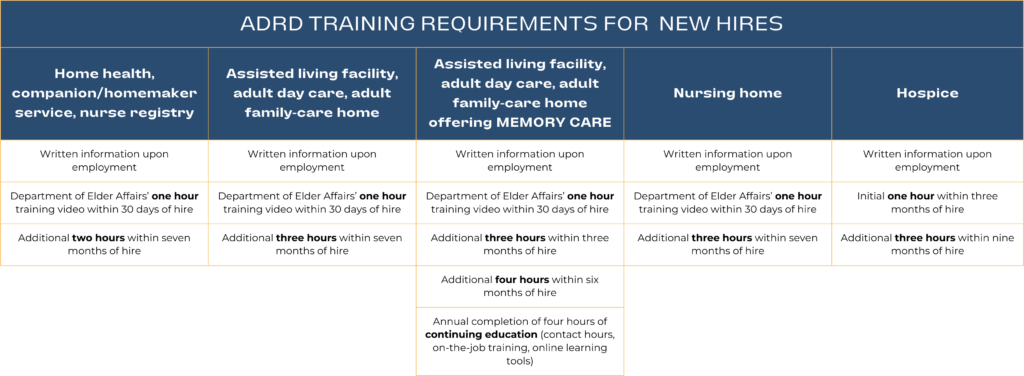
- Complete additional Department-approved training if you provide personal care. The type of training depends on the setting where you work:
Other Important Notes
- If you work for a health care services pool, you must follow the training rules for the specific care setting where you are placed.
- If you work in an ALF with a limited mental health license, you are not required to complete the additional ADRD training.
Written Information for New Employees
All new employees must receive written information from their employer about how to interact with people who have Alzheimer’s disease or other dementias.
- The Department of Elder Affairs offers this written information for use below:
- Employers may use this version or must provide their own, as long as it meets the requirements in section 430.5025, Florida Statutes.
What About Hospice?
Hospice providers are not included in section 430.5025, Florida Statutes. They must continue to follow Florida Administrative Code Rules 59A-38.019 and 59A-38.020, as required by section 400.6045, Florida Statutes. Visit https://www.flrules.org/ for more information.
One-Hour Training
This training must be completed here on the Department of Elder Affairs website to receive a certificate of completion. Before starting the training, please follow these steps:
- Make sure you are watching the training on the Department of Elder Affairs official website.
- Clear your browser’s cache: Press CTRL + F5 on your keyboard while on this page.
- When the training ends, do NOT close the page. Wait up to 30 seconds for the form to appear.
- The certificate request form may not work properly on mobile devices. It is highly recommended you use a desktop computer.
Important:
- You must watch the training by yourself (NOT in a group).
- If you watch the training on any other website, you will NOT get a certificate.
- This program does NOT support group training.
- You only need to take this training once.
- Taking this training multiple times will NOT generate a new certificate with a different completion date.
- Please KEEP your original certificate. Your employer will need it to verify proof of training.
- If you get a new job, you can give a copy of your certificate to your new employer. You do NOT need to retake the training.
What Happens After You Finish
- When the training ends, you will be automatically sent to a form to request your certificate.
- Please wait up to 30 seconds for the page to change.
- Fill out the form completely and click submit.
- Enter your information slowly to make sure your name and email are correct. Your certificate will use the exact information you enter.
- You will get your certificate within five business days.
- We cannot expedite certificate delivery. Be sure to check your spam/junk folder, as certificates commonly land there.
How to Make Sure the Certificate Request Form Works
Before starting the training, please follow these steps:
- Make sure you are watching the training on the Department of Elder Affairs official website.
- Clear your browser’s cache:
Press CTRL + F5 on your keyboard while on this page. - When the training ends, do NOT close the page.
Wait up to 30 seconds for the form to appear. - The certificate request form may not work properly on mobile devices. It is highly recommended you use a desktop computer.
After You Get Your Certificate
- You are responsible for giving a copy of the certificate to your employer.
- Employers must keep a copy of the certificate in your personnel file.
- The Agency for Health Care Administration (AHCA) will check for this during routine monitoring visits.
Questions or Issues?
The Department has developed a document outlining important information regarding this training program and certificate delivery. Click here to view and download.
If you still have questions about your certificate or encounter any issues not listed on this document, please email abh@elderaffairs.org. You will receive an automated response with important information that answers most common questions, including a link to retrieve your certificate if you have not received it within five business days of completing the training.
Please note:
We cannot expedite certificate delivery. Be sure to check your spam/junk folder, as certificates commonly land there.
Watch the Required One-Hour Training Video Below
Become an Approved Training or Curriculum Provider
Section 430.5025, Florida Statutes requires that anyone who provides the additional training on Alzheimer’s disease and related dementias (ADRD) in licensed care settings must:
- Obtain approval from the Department of Elder Affairs, and
- Use training materials (curriculum) that have been approved for each care setting.
This process ensures that ADRD training throughout Florida is consistent, accurate, and aligned with state standards.
Apply to Become a Training Provider
Individuals who wish to provide ADRD training must first be approved as a training provider. Submit one application, and the Department will determine eligible care settings based on your qualifications.
ADRD Training Provider Approval Application
Apply for Curriculum Approval
All ADRD training curriculum must be reviewed and approved by the Department before it may be used in a training program. Curriculum approval is valid for three years. Submit a separate application for each type of training you intend to offer:
ADRD Curriculum Approval Application
Review the content requirements for each level of training:
If your curriculum includes content developed by another organization or author, you are responsible for ensuring proper copyright compliance, providing proper credit or citations, and obtaining written permissions when required. Failure to provide proper documentation of permissions may delay or prevent approval.
Important Notes and Reminders
- Trainer approvals do not expire.
- Curriculum approvals expire 3 years from the approval date.
- Any curriculum approved before July 1, 2023, will remain valid until its original expiration date.
- Provide a copy of your trainer approval letter and curriculum approval letter to every agency where you deliver training.
- If you are using someone else’s approved curriculum, you must obtain a copy of their approval letter and maintain it in your records.
- Trainers must follow the content and structure of the approved curriculum exactly as approved.
Certificates of Completion
Approved trainers are responsible for issuing a certificate of completion to each training participant. The certificate must include:
- Name of the training program
- Number of training hours
- Curriculum approval number and expiration date
- Trainee’s full name
- Date and location of the training
- Trainer’s printed name, signature, date, and trainer approval number
Training – FAQs
Please be advised that the Department reserves the right to amend or adopt new rules related to the establishment of training curricula guidelines and requirements for the approval of other qualified training providers. The following answers are based on current best practices.
Required Training Questions
Q: Who is required to complete the initial 1-hour training?
A: Anyone who works or volunteers in a place that serves people living with dementia and must pass a Level-2 background check. This includes people who:
- Spend time with participants or residents on a regular basis
- Help with daily tasks, such as giving medicines, bathing, dressing, or meals
- Support their physical, mental, or emotional well-being
If the person has regular contact with people living with dementia, they need to complete the 1-hour training.
Q: Are volunteers or contractors required to complete the one-hour training program?
A: Yes. Volunteers or contractors must take the one-hour training if they:
- Are required to pass a Level-2 background check, and
- Provide personal care or have regular contact with people living with dementia
Regular contact can include things like:
- Talking with or helping participants every day
- Helping with medicines or other daily tasks
- Helping with bathing, dressing, or meals
- Supporting a person’s physical, mental, or emotional well-being
Q: Who has to complete the additional 2-hour, 3-hour, or 4-hour training?
A: Anyone who works or volunteers in a place that serves people living with dementia and provides personal care or has regular contact needs to complete the additional training. The amount of training depends on where they work.
People need to complete additional training if they:
- Give personal care to participants or residents
- Spend time with them on a regular basis
- Help with daily tasks, such as medicines, bathing, or meals
- Support their physical, mental, or emotional well-being
Q: Can I use a different 1-hour training program instead of the Department’s video?
A: No. Section 430.5025, Florida Statutes states the initial 1-hour training must come from the Florida Department of Elder Affairs. No other training course can be used to meet this requirement.
Hospice agencies are the only exception.
Because they were not included in the new law, hospice agencies may choose to use the Department’s 1-hour training video or submit their own 1-hour training for approval.
Q: Do employees who already took required dementia training in the past still need
to complete the Department’s 1-hour training program?
A: Yes. If an employee was hired before July 1, 2023, they have until July 1, 2026 to complete the Department’s 1-hour training program.
If an employee was hired on or after July 1, 2023, they must complete the 1-hour training program within 30 days of their hire date.
Q: Do employees need to retake the ADRD training if they change employers?
A: It depends on the care setting.
- If the employee stays in the same type of care setting(for example, they move from one assisted living facility to another), they do not need to redo the same ADRD training they already completed.
- If the employee moves to a different type of care setting(for example, from a home health agency to an assisted living facility), they must complete the training that matches their new setting.
The law does not allow swapping one type of training for another.
Q: What is the difference between “having regular contact with” and “providing personal care to” people living with dementia?
A: Personal care means helping someone with their daily needs. This can include:
- Helping with bathing, dressing, eating, or using the bathroom
- Helping someone take their medicine
- Doing homemaker or companion services
- Providing nursing care
- Doing any tasks that support a person’s physical, mental, or emotional well-being
Regular contact means you see or talk with the person every day as part of your job, even if you are not giving personal care. This includes any duties that require in-person interaction on a daily basis, such as greeting them, checking them in, supervising activities, or being in shared spaces with them.
Q: Do employers need to create their own basic written information, or is there one employees can get from the Department?
A: Every care setting must give new employees basic written information about how to interact with people living with dementia when they start their job. Employers can make their own written information if they want to, but they do not have to.
The Department has already created a free, ready-to-use basic written information packet that any employer can download and give to their staff here.
Q: Who has to complete continuing education?
A: Continuing education is only required for employees who work in:
- Assisted living facilities,
- Adult day cares, or
- Adult family-care homes
that provide specialized dementia care (for example, “memory care” programs).
If an employee works in one of these settings, they must complete:
- 4 hours of dementia continuing education every calendar year.
These hours can come from:
- In-person classes (contact hours)
- On-the-job training (up to 2 hours per year)
- Online or electronic learning
The Department does not approve or review continuing education materials.
Training Provider Questions
Q: Are trainers that were previously approved by the University of South Florida still approved?
A: Yes. Any trainers that were approved before July 1, 2023 are still valid under the new law. Trainer approvals do not expire at this time.
Q: How do I become an approved training provider for the State of Florida?
A: To become an approved trainer, you must fill out the online application for the care setting you want to teach in. You will also need to upload documents that show your training, credentials, and experience.
You can find more information about the approval process and online applications here.
Q: Is there a training provider application fee?
A: No. There is no cost to apply to become an approved training provider for the State of Florida.
Q: How long does the approval process take?
A: The Department usually reviews training provider applications within 30 days after they are received. Sometimes the review may take longer if unexpected circumstances warrant a longer review process.
Q: As an approved training provider, in which care settings can I conduct training?
A: You may only give training in the care setting you were approved for.
If you want to train in more than one type of care setting, you must submit a separate application for each one.
Curriculum Questions
Q: Are training curricula that were previously approved by the University of South Florida still approved?
A: Yes. Any training curricula that were approved before July 1, 2023 are still valid under the new law. Training curricula stay valid until their original expiration date, which is three years after they were first approved.
Q: My curriculum was approved as a 4-hour training before July 1, 2023. The law now requires only three hours for my care setting. Can I still use my 4-hour training?
A: Yes. If your curriculum was approved before July 1, 2023, it is still valid. You do not have to change it. If you want to shorten it from four hours to three hours, you can, but you must still teach every part of the approved content. Nothing can be removed.
It is your job as the training provider to make sure the full approved content is taught and that it meets the rule for your care setting.
Q: Where can I find an approved curriculum that meets the ADRD training rules for my care setting?
A: You can view a list of approved curricula here. Each curriculum shows the creator’s contact information. You will need to contact the creator directly to ask:
- whether the curriculum is available for purchase, and
- what the cost will be.
The Department does not set, endorse, or monitor the pricing of training curricula. Costs may vary by provider.
Q: How do I submit my own curriculum for approval?
A: To submit your curriculum, fill out the online application for the care setting you want to create training for, and upload all required documents. The application link is available here.
Q: Is there a curriculum application fee?
A: No. There is no cost to submit a curriculum application.
Q: How long does the approval process take?
A: After we receive your curriculum, it is sent to a subject-matter expert (SME) to review the content. The review typically takes about 30 days from the day it is sent to the SME.
The Department may need more time if something unexpected happens or if the review requires extra attention.
Q: Once my curriculum is approved, in which care settings can it be used?
A: Your curriculum can only be used in the specific care setting you were approved for. If you want your curriculum to be used in more than one care setting, you must submit a separate application for each setting.
Trainer & Curriculum Providers Search
Tips for Using the Search Tool
- Use the search bar to find a trainer’s name, organization, or care setting
- Click on a name to view additional details and contact information
- Contact the provider directly with questions about their training schedule, materials, or pricing
| Name | Care Setting | Organization | City | County |
|---|
| Name | Care Setting | Format | Training Type | Organization | City | County | Expiration |
|---|